Whole-Home Mold Remediation in American Fork, UT
The house sat empty over the holidays, the furnace failed, and a supply line on the second floor split and ran for four days before a neighbor noticed water under the garage door. Or the ice dams last winter pushed melt under the shingles for two months and every upstairs ceiling has a stain. Or the basement has taken groundwater three springs in a row and the smell has moved up the stairs. One patch is a repair. This is a project. This site connects you by phone with an independent local provider who does whole-home mold remediation in American Fork and across Utah County.
What the crew does first
A whole-house job is planned floor by floor before anything is opened. The crew walks the house with a moisture meter and marks every wall, ceiling, cabinet, and floor that reads wet, then maps where the water traveled. On a burst-line house that is usually a path straight down: the ceiling below the leak, the wall cavities it followed, the subfloor, and the basement below.
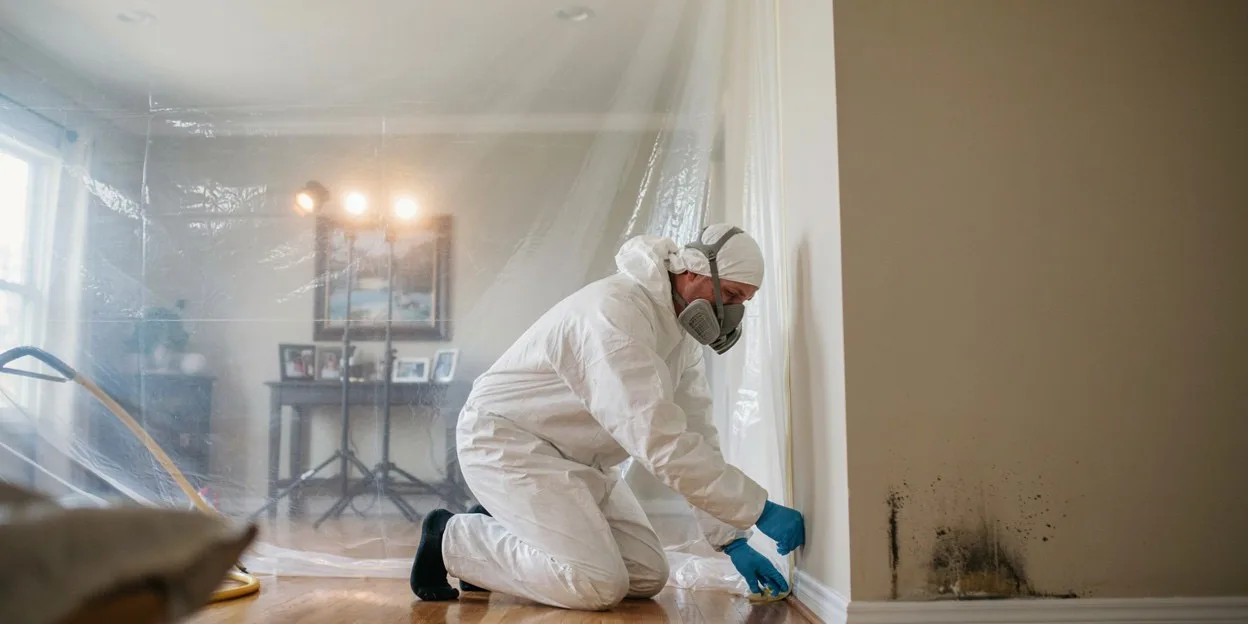
Then they build containment in stages. Rather than one plastic wall at a door, they seal the house in zones, run negative air in the zone being worked, and cover every register so the furnace is not pulling dust through the ductwork. Belongings get sorted into three groups: hard items cleaned in place, soft items cleaned off-site, and porous items that go.
What to do in the next hour
Get the water off if it is still running, and get the heat back on if the house is cold. A cold, wet house dries slowly and grows mold anyway; a heated one with the furnace fan off can start drying. If the furnace itself smells when it runs, say so, because the blower cabinet and coil may be part of the job and HVAC mold cleaning gets folded in.
Do not start hauling things to the curb. Photograph every room first, including the contents and the water path, because an insurance claim on a whole house depends on that record. Do not run box fans through the house. They move spores from the wet rooms into the dry ones.
What is usually saved and what is removed
On each floor the wet drywall and ceiling board come out to a line past the last wet reading, along with insulation and any paper-faced material behind it. Wet subfloor, carpet pad, and laminate underlayment go. Solid framing, concrete, tile, and cabinets with solid bottoms get cleaned, HEPA vacuumed, and dried in place.
After removal, drying equipment runs floor by floor until framing, subfloor, and slab read dry. Fixing the source is part of the job, whether that is a plumber, a roofer, or a sump and grading fix on a basement that keeps taking water. If the basement is the whole story, basement mold remediation is the narrower version of this page. When the house is dry, mold damage repair puts the finishes back.
Utah County notes: freezes, ice dams, and houses that sit empty
The whole-house calls in Utah County have a winter shape. December and January cold snaps split supply lines in exterior walls, unheated basements, and homes where the furnace quit while the family was away. Ice dams on north-facing eaves push melt back under shingles in older homes from downtown American Fork to Pleasant Grove that have little attic insulation and no ice-and-water barrier.
The other shape is the basement that floods every spring. Homes on the valley floor near Utah Lake in west Lehi, Vineyard, and Saratoga Springs sit close to the water table, and a wet year like 2023 brings groundwater up through the slab two or three springs running. By the third time, the growth has reached the floor system above.
Utah does not license mold remediation as a separate trade, and there is no state rule separating assessment from removal. The crew works under a state contractor license for the cutting and rebuild. Many policies treat a burst pipe as a covered loss and groundwater as excluded; ask your adjuster before the work starts.
Calling about whole-home mold remediation
Have the address, what happened, how long the house was wet, and whether anyone is living in it now. Say whether the water is stopped and whether a claim is open. Call (385) 534-4662.